When a patient looks for invisible orthodontics, they often think of it as a way to get straighter teeth and improve the aesthetics of their smile.
But orthodontics is not just about moving teeth.
In certain cases, the main objective is also to correct the bite and improve the relationship between the upper and lower teeth.
This case treated at Varchi Dental Clinic, in Sant Just Desvern, is a good example.
The patient presented with several bite abnormalities that had to be taken into account in the treatment planning:
- Crossbite in the area of the second left premolars.
- Open bite from the lateral incisors to the second premolars.
- Edge-to-edge contact on anterior teeth.
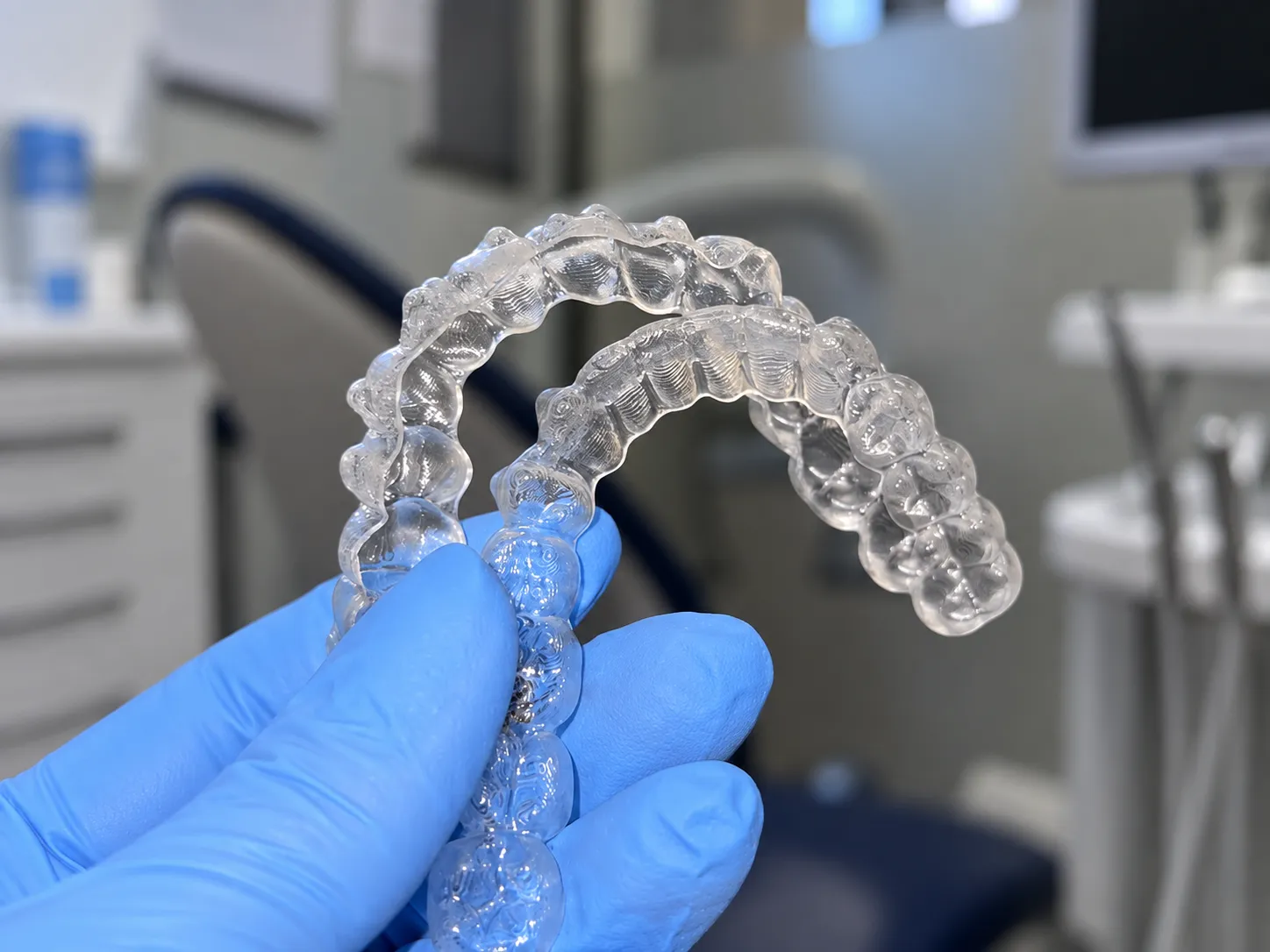
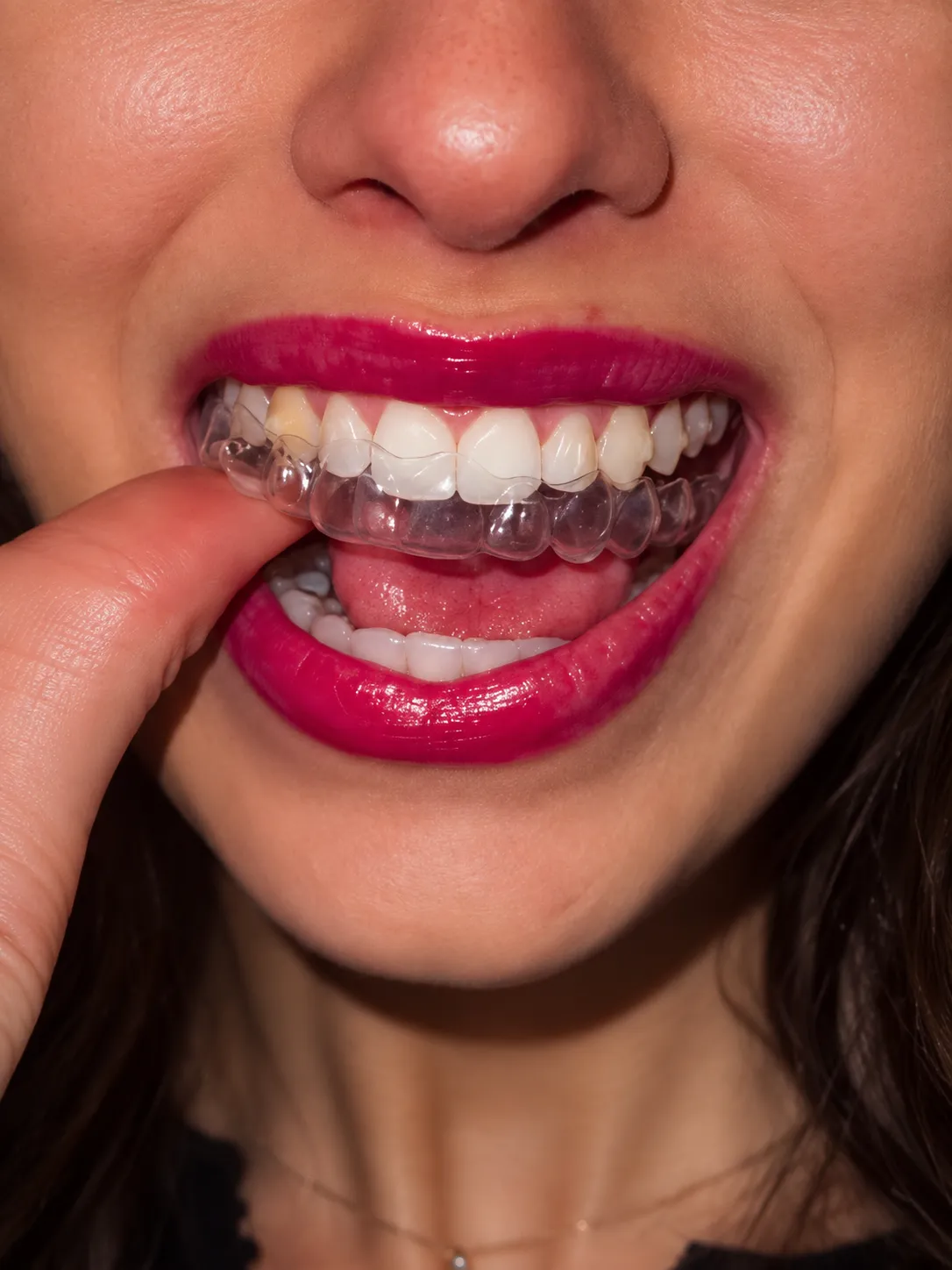
The treatment was performed using Spark™ invisible orthodontics, with a customized plan to work on both the position of the teeth and the relationship between both arches.
Approximate duration of treatment: 15 months.
What was the patient’s condition before treatment?
Before starting any orthodontic treatment, it is important to identify exactly what problems the patient has.
In this case, it wasn’t simply a matter of teeth that were slightly misaligned.
There were different alterations in the way the upper and lower teeth contacted each other, so the goal of the treatment had to go beyond achieving a visually more aligned smile.
The patient presented with an open bite, a crossbite in the posterior left area, and an anterior edge-to-edge contact.
All of this had to be taken into account before starting to plan movements with clear aligners.
What is an open bite?
An open bite is a condition in which certain upper and lower teeth do not make proper contact when the mouth is closed.
Depending on the area where it occurs, it can affect the front teeth or the back teeth of the dentition.
In addition to its aesthetic component, an open bite can influence certain functional aspects of the mouth.
Therefore, when performing orthodontic treatment, we should not always only ask ourselves if the teeth are straight, but also how they contact each other.
In this case, the patient presented with an open bite that extended from the lateral incisors to the second premolars.
What is a crossbite?
A crossbite occurs when one or more upper teeth are positioned inside the lower teeth when the mouth is closed, when the expected relationship would be the opposite.
It can appear in different areas of the mouth and can have different causes.
In this specific case, there was a crossbite in the second left premolars, which was part of the alterations that we had to address during treatment.
Correcting a crossbite requires carefully studying the relationship between both dental arches and planning the necessary movements to achieve a more suitable relationship.
What does it mean to have teeth edge to edge?
Another initial characteristic of this case was the edge-to-edge contact on the anterior teeth.
This means that the edges of the upper and lower teeth made direct contact with each other, instead of having the usual vertical relationship.
Although it may seem like a small detail when only looking at a frontal photograph, the bite must be analyzed from different perspectives to truly understand the patient’s situation.
Therefore, in an orthodontic assessment in Barcelona or Sant Just Desvern, photographs are only one part of the diagnosis.
How was this case corrected with Spark™ invisible orthodontics?
To treat this case we used Spark™ invisible orthodontics, through a personalized digital planning.
The goal was not simply to achieve a more aligned smile.
The planning had to consider different dental movements to work simultaneously on the position of the teeth and on the relationship between the arches.
This is one of the most important aspects of orthodontic treatment: each movement must respond to a specific clinical objective.
The clear aligners were used progressively and the case was monitored throughout the treatment to check its progress.
Can a bad bite be corrected with invisible orthodontics?
In certain cases, yes.
Invisible orthodontics with clear aligners can be used to treat different bite problems, but the possibility and the way to do so depend on the characteristics of each patient.
Not all open bites or crossbites are the same.
That’s why it’s necessary to make an individualized diagnosis before determining if clear aligners are a suitable option.
In some cases they may be sufficient. In others, it may be necessary to combine different techniques or use other types of equipment.
The decision should be made after studying the case and not solely based on the patient’s aesthetic preferences.
How long did this invisible orthodontic treatment last?
In this case, the treatment lasted approximately 15 months.
During this time, checks were carried out to verify the progress and to assess that the planned movements were developing correctly.
The 15-month duration corresponds to this specific case and should not be interpreted as a standard duration for all Spark™ invisible orthodontic treatments.
Each patient presents a different situation and, therefore, needs a different treatment plan.
What do we look for in orthodontic treatment?
One of the most common mistakes is thinking that the goal of orthodontics is simply to achieve perfectly aligned teeth.
The aesthetics of the smile are important, but so is its function.
Good orthodontic planning must take into account the position of the teeth, the relationship between the arches, and the way the bite functions.
In this case, for example, the goal wasn’t just to improve tooth alignment. We also wanted to address the open bite, crossbite, and
The final result must therefore be evaluated from both an aesthetic and functional perspective.
Why is it important to personalize invisible orthodontics?
Because every smile has different characteristics.
The same sequence of aligners does not work for all patients, and a treatment that may be suitable for one person may not be suitable for another.
At Varchi Dental Clinic, our approach to invisible orthodontics in Barcelona and Sant Just Desvern always starts with an individual diagnosis and defined objectives before beginning.
Aligners are a very useful tool, but the outcome depends on how each case is diagnosed, planned, and monitored.
The experience of our Dr. Claudia Del Core, an orthodontist specializing in Orthodontics and Dentofacial Orthopedics, allows us to address each case taking into account not only the aesthetics of the smile, but also the function and the bite.
The result: more than just a straight smile
After approximately 15 months of treatment with Spark™ invisible orthodontics, we were able to improve the position of the teeth and work on the bite alterations that the patient initially presented.
The before and after allows you to appreciate the change, but behind these photographs there is a whole process of diagnosis, digital planning, controls and follow-up.
Every smile needs a diagnosis.
Every diagnosis needs a plan.
And each plan must be adapted to the person in front of us.
At Varchi Dental Clinic in Sant Just Desvern, we work to ensure that invisible orthodontics is not limited to achieving straighter teeth, but allows us to achieve an aesthetic, functional result adapted to each patient.