
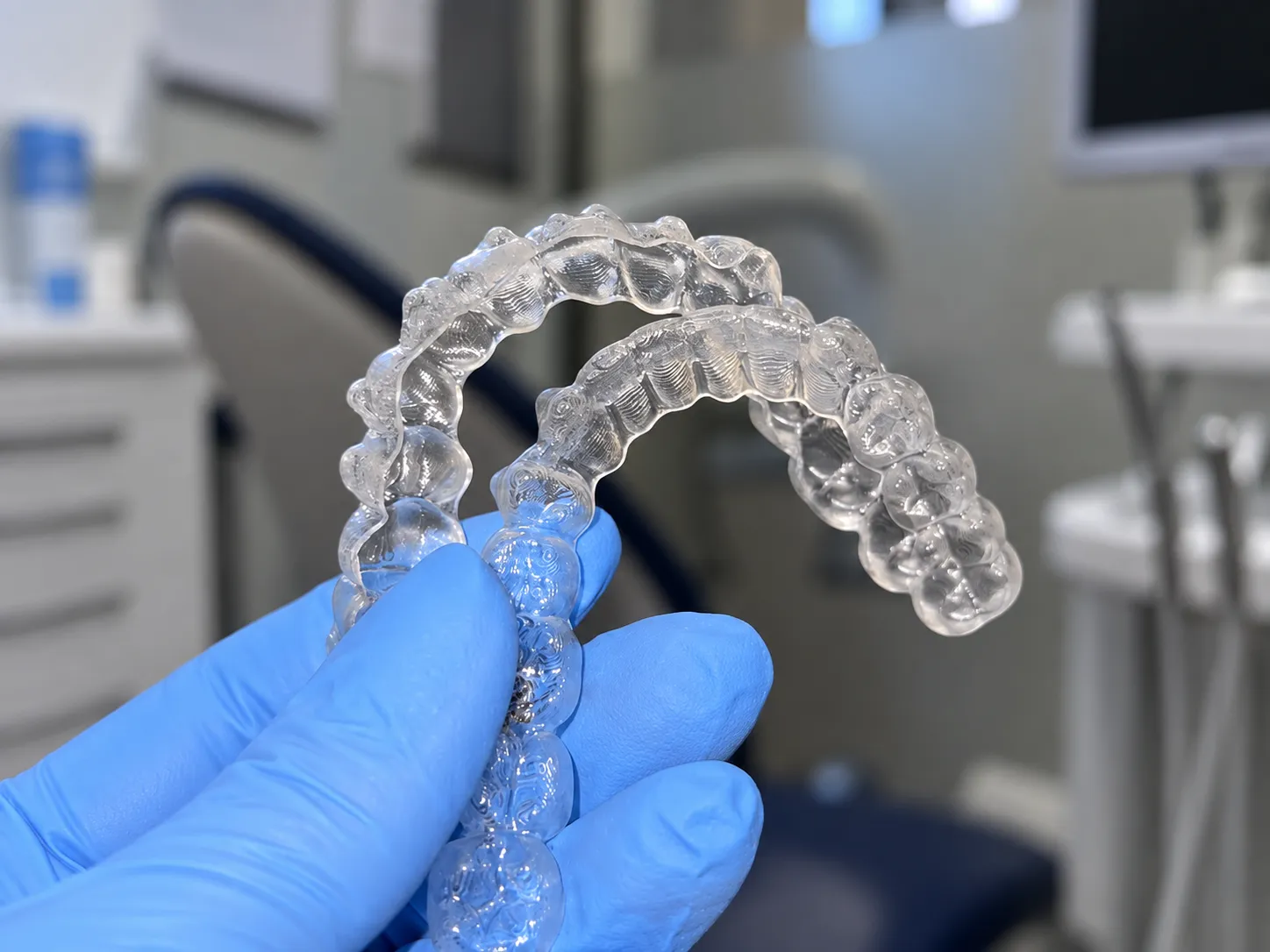
If you’re thinking about starting invisible orthodontic treatment with Invisalign® or Spark™, you’ve probably noticed that many patients have small, tooth-coloured protrusions. They’re discreet, but they catch the eye and raise lots of questions: what are attachments? What are they for? Are they necessary? Do they hurt? Can you see them? Can they fall off?
It’s one of the questions I’m asked most often in my practice, and the answer is simple: attachments are a fundamental part of the treatment. Although they are small, they enable the clear aligners to move the teeth with much greater precision and achieve results that would be much more difficult to attain without them.
What exactly are attachments?
Attachments are small composite build-ups – made from the same material we use for many dental restorations – and are crafted to match the natural colour of your teeth so that they are virtually invisible.
They are not part of the aligner. They are temporarily bonded to specific teeth and act as anchor points so that the clear Invisalign® or Spark™ aligners can apply the necessary force in the correct direction.
We could say that they are the ‘steering wheel’ that guides some of the most complex movements in invisible orthodontics.
Every patient needs different attachments. They do not all have the same shape or size, nor are they placed on the same teeth. It all depends on the digital treatment plan and the movements we wish to achieve. That is why every orthodontic treatment using clear aligners is completely personalised.
Why are they so important in invisible orthodontic treatment?
One of the major advantages of invisible orthodontics using clear aligners is that it allows treatment to be planned digitally even before it begins. However, for that plan to become a reality, the aligners need to apply the correct amount of force to each tooth.
And that’s where attachments come into play.
Thanks to these, we can carry out much more precise movements, such as rotating teeth that are severely rotated, correcting dental crowding, closing gaps between teeth, improving the bite, moving tilted teeth or repositioning specific teeth with much greater control.
In other words, attachments ensure that treatment follows the plan drawn up by the orthodontist exactly and that the final result is more predictable.
How do we attach the attachments?
Many patients come to the clinic thinking that fitting attachments is a complicated procedure or one that requires anaesthesia. The reality is quite different.
It is a quick, completely painless process that is usually carried out on the same day that we hand over the clear aligners.
First, we prepare a transparent template designed specifically for your treatment and fill it with tooth-coloured composite. We then protect your lips to ensure your comfort and gently prepare the surface of your teeth where the attachments will be placed.
We apply a special adhesive, position the template and use a light-curing lamp to harden the material in just a few seconds. Once we remove the template, the attachments are ready to start working alongside your aligners.
The whole procedure usually takes just a few minutes and is painless.
Are they very noticeable?
This is another of the most common concerns amongst patients looking for a cosmetic alternative to traditional braces.
As they are made from a material the same colour as your teeth, attachments tend to go largely unnoticed. It’s true that, if you look very closely in the mirror, you can see a slight raised area, but when you’re wearing your clear aligners, they’re even less noticeable.
Most patients stop paying attention to them a few days after they have been fitted.
Do attachments hurt?
No.
Fitting the attachments does not hurt, as they are simply bonded to the surface of the enamel and do not require anaesthetic or involve drilling into the tooth.
What you might notice during the first few days is a different sensation when you run your tongue over your teeth. This is completely normal.
Just as with any invisible orthodontic treatment, it takes the brain a few days to get used to them. After that, they stop attracting attention and most patients don’t even remember they’re wearing them.
What happens if an attachment comes loose?
Although they are designed to remain in place throughout the course of treatment, they may occasionally come loose when biting into something very hard or for any other reason.
It’s not usually an emergency, but it’s important to let your orthodontist know.
Each attachment has a specific role in the treatment and, depending on the movement that tooth is undergoing, it may be advisable to refit it before moving on to the next set of aligners.
Are they removed once the treatment is complete?
Yes.
Once the active phase of invisible orthodontic treatment with Invisalign® or Spark™ is complete, we carefully remove all the attachments and polish the enamel to restore the tooth’s completely smooth, natural surface.
They do not leave marks or damage the enamel when fitted and removed correctly.
A small detail that makes a big difference
Patients often think that the success of treatment with clear aligners depends solely on wearing the aligners for the recommended number of hours. And it is true that this is very important. But it is also important to understand that behind every smile lies very precise planning.
Attachments form part of this treatment plan. They are small, discreet and temporary, but they play a vital role in ensuring that the teeth move exactly as we want them to.
That is why, when we fit an attachment, we don’t do it just for the sake of it. Each one has a specific reason, position and function. It is one of those small details that often go unnoticed, but which make the difference between simply wearing invisible braces and undergoing a properly planned treatment.